top to bottom: 63rd Manchester foot, 44th Essex foot and 20th Lancashire fusiliers
Having invaded Saxony several months earlier the French forces of king Louis XV have been hard pressed on the heels by Frederick and his superbly drilled Prussian army.
After falling back as far as the village of Erfurt, Charles de Rohan prince of Soubise decided to detach several units from the regiments newly arrived from India. These forces dug in near the town of Erfurt in preparation of the advancing Prussian army.
Frederick joined Baron Von Stueben and Prince Henri in his vanguard alongside the elite Prussian foot regiments, the irregular cavalry and the British detachments that had been sent to support him against the French.
As the Vanguard approached the road to Erfurt there came in to view a line of French troops on the other side of a ridge.
I've not managed to post for quite some time as I haven't been fighting any battles, what with the Olympics and everything, but I've managed to get quiet a bit painted and so this week we decided to have a seven years war bash using the last arguments of kings supplement to Black powder. Apologies for the poor quality photos, but my camera still isn't fixed and after getting back later than intended from my athletics club it was rather dark, I have acquitted this to the earliness of the morning at which the attack happened..
In the centre of the Prussian line "Ol' Fritz" stood in command of the Prinz von Braunschweig-Bevern's own 7th Kanitz grenadiers and Von Wickeradt's own 9th musketeers, two of the most elite units in the Prussian army advancing through Saxony.
To the right Baron Von Steuben was in command of the three British detachments from the 63rd, 44th and 20th regiments of foot, supported by a medium sized artillery piece manned by Hanoverians.
To the left Prince Henri stood in command of the Irregular cavalry, the Turkish-Albanian Bosniaken lancers, Von Szekely's 1st hussars and the Bavarian deserters of the 1st Dragoon regiment. (These cavalry, Especially the Bosniaken, came in for a lot of bad press from my opponent who deemed them undisciplined troops who'd turn tail at the merest whiff of powder.) Markgraf Friedrich von Brandenburg's own Cuirassiers had been scouting ahead and had all been surrounded and captured by the French leaving the other cavalry to attempt a breakthrough on their own.

With the rest of the vanguard in their positions Prince Henri rode to join his cavalry and ordered the charge. As he spurred his horse towards the enemy positions in the crop fields, he was overtaken by the charging Albanian lancers who thundered on towards the French gun. The cavalry were within two bounds of a horse's distance but the french guns were now loaded and as the men presented their arms Prince Henri could do nought but close his eyes and rally the survivors.
In the centre the magnificent king of Prussia stood atop the great mound in the centre of the field alongside the Kanitz grenadiers with the 9th foot covering his flank. He was facing off against the French Bulkeley Irish foot.
To the right von steuben had moved his British contingents forward perfectly, moving and unlimbering the cannon within range to pound the french line with round shot. The Manchester foot were positioned to guard Frederick's right flank and anchor the British line to the central hill whilst it was the Lancashire Fusilier's job to hold the British flank against the French hussards.
The French Bercheny and Royal Nassau Hussards came forwards at a gentle trot to threaten the British flank with the intention of rolling breaking down the British contingents and rolling up "Ol' Fritz's" line. However they were currently not making the same kind of progress that their Prussian counterparts had.
La Marine Infanterie holding the central crop fields.
Bulkeley Irish foot positioned around the French commander's staff position in the woods.
De Bussy's Volontaires, recently back from India with their wide variety of ethnical troops from all over the French empire.
The Bourbonnais Infanterie holding de Bussy's flank in preparation of the cavalry charge about to hit them.
Prince Henri's cavalry received the French volley like the Irregulars they were with both the Hussars and Dragoons turning tail after the merest sniff of powder smoke. The Bosniaken on the other hand, though far from being known for the steadiness in the face of fire, readied their lances for the charge and took the volley like men. Afterwards there would surely be words from Henry to the other German cavalry about being shown up by heathens!
In the centre both lines were steadily advancing upon each other with the French stubbornly refusing to abandon their covered positions in order to come within range of firing on the allies, however the British gun was already within range enough to fire off accurate shots into the French line and could quite happily pound away at their lines for sometime.
And as the Anglo-Hanoverian crew let off the first shot into the ranks of the French Marines positioned in the crop fields it became clear that the French would not be able to hold out indefinitely against the Prussian and British aggressors and would soon have to leave their positions if the Prussians too refused to abandon theirs.
Meanwhile on the left the Albanian lancers, having taken out the French artillery with their first charge, now turned their charge upon the Indian volunteers. As they came on they received a ferocious salvo of musket shots from the regiment at close range, but remarkably the Bosniaken stood their ground and struck home at the Volunteers with the weight of their lances.
Both sides held and continued to batter away at each other, but with their charge halted and the Bourbon foot marching on their flank the Turks would almost certainly be running soon.
On the right flank the French hussars finally took the charge, the Bercheny Hussards crashing into the ranks of the 44th Essex despite taking significant losses from the Musket fire delivered from the Englishmen as they closed.
The Battle was a short affair with the British infantry falling back to regroup in anticipation of a second charge. Bercheny's hussars were forced to redress the ranks and regain order rather than pressing the charge and without the support of the Royal Nassau cavalry, who had stubbornly refused to obey the order to advance, they were now at the mercy of enfilading shots from the British artillery in their flank.
Over with Prince Henri the Bourbonais had delivered a decisive flank charge on the Turkic lancers who, in chaotic disorder, fled after the other Prussian cavalry. But again remarkably they regained order around Prince Henri and, no doubt remembering their ancestors defeat of French crusaders on the plains of Nicopolis, readied their lances for yet another charge on the Frenchmen who dared to attempt a flank assault on their great king's position.
The Prussian 9th now commenced firing upon the Irish regiment positioned opposite the hill. The Irish received the volley with a good deal of surprise, they had not expected Frederick to commit his troops to advancing on the French positions when they could just pound at them with the artillery, and quickly fell into disorder.
The British flank, having sent point blank enfilading shots straight through the French cavalry, quickly followed by a volley from the 44th, now redressed their line and, under the orders of Baron Von Steuben, marched on to within range of the French who were also advancing on their lines.
Frederick still stood upon the hill with the Kanitz Grenadiers, unready to commit himself in abandoning his strategic point of advantage till the last moment, whilst the rest of the Allied forces encircled the French positions.
Prince Henri, diving straight into the regrouping ranks of the Albanians, spurred them on and pressed them into a charge on the French volunteers. However this was their last chance and after pinning down the French left flank for so long they finally beat a hasty retreat, closely followed by a disappointed glory seeking prince
With his cavalry fallen Frederick now decided to commit his Grenadiers and they marched down the slopes towards the French detachments making their stand.
All along the Anglo-Prussian line firing commenced and shots crashed into the French line. The French Marines in the centre of the line took the brunt of the firing, finally turning tail their morale broken. The Irish continued to take heavy looses which worsened their disorder and sent them retiring back towards their commander. But on the right the Belzunce infantry held firm despite the heavy firing from the British detachments.
The Field was named a Prussian one with a large clean hole punched straight through the French centre. The French held the Left flank and could possibly (but only Possibly) make the best of the Royal Nassau horse and make some head way on the right as well but this was doubtful. It was clear that the Allies would now be able to wrench open the hole in the centre of the French line and tear apart the rest from that.

Prince Henri's cavalry had done their part in holding the Left flank and despite poor quality troops they had made the best of a bad deal and done their duty remarkably.
This was my first proper taste of seven years war warfare and it more than lived up to expectation, I've been getting out of the habit of wargaming recently but I believe this has got me back in to the swing of it. I've currently got plans for a seven years war Spanish army with units from Havana as well as some from mainland Spain and Italy.


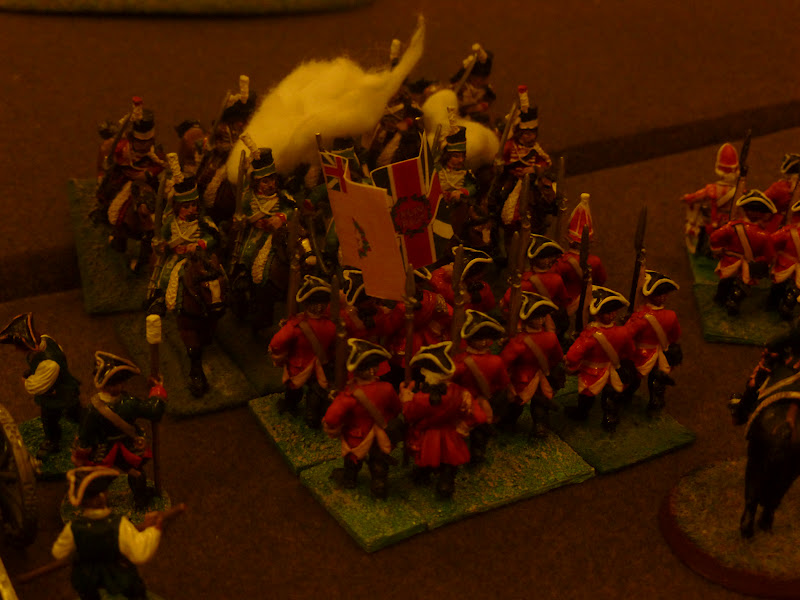


 Prince Henri's cavalry had done their part in holding the Left flank and despite poor quality troops they had made the best of a bad deal and done their duty remarkably.


