Monday, 30 July 2012

Battle of Sabugal 1811

I was in Deal again recently, so one evening I dropped in on the wargaming club to have a game with Adrien White. Recently I've been doing allot of gaming with my 20mm Napolonic French and having just signed on with the 42nd highland regiment re-enactors I've been painting up my British force as well (I'm also planning several napoleonic skirmish armies inspired by Sharpe for use with Sharp practice). Of course the kind of forces I use make a cafe table at the local sport's centre look quite colourful, but for this game they made up a small percentage of two much larger armies on a great 10 ft by 6 ft table! I was in command of the French (as normal) with Adrien playing British.
The battle was a recreation of the battle of Sabugal 1811 and we used black powder rules.

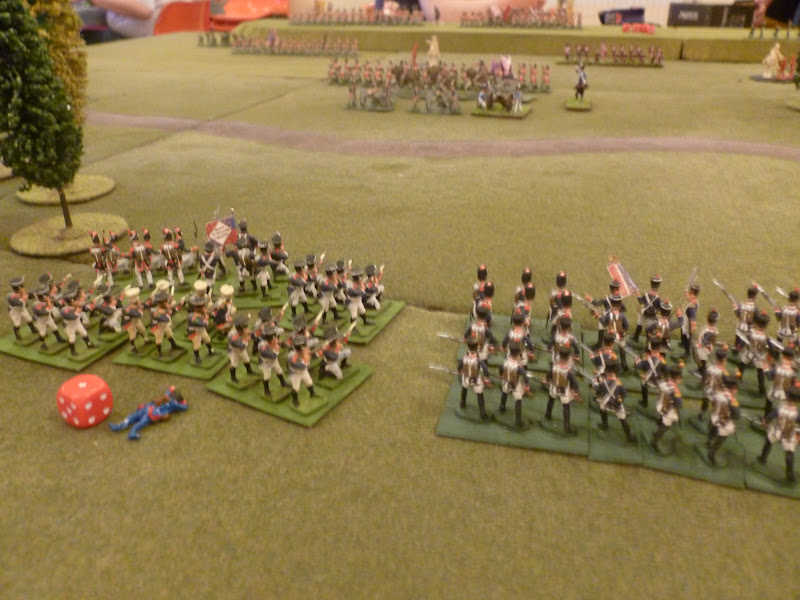
The right hand brigade of my French line was made up of (from left to right) a small platoonn of French line across the river, a platoon of swiss regulars, a platoon of French line and a platoon of Westphalians from Germany. All were under the command of Brigadier Dubreton (who you will remember from several other games I have fought using my French, and yes he did appear in Sharpe's enemy).

The Centre of the French line was where the majority of my force was placed, with its flanks secured between the village and the woods. (from left to right) The first brigade, under Brigadier Montrand, was made up of a large battery of three artillery pieces, a platoon of Voltiguers, a company of the Imperial Old guard and a platoon of French line. General Jean Reynier was also positioned in the centre to help with moving the artillery forwards.
Deplyed behind the woods, under Brigadier Balliard, was the large cavalry brigade containing the Bavarian Dragoons to the front with the mounted Guard Grenadiers behind them and the Empress Dragoons behind them.

On the French left, under Brigadier Valmont, (from left to right) were two batteries of two artillery pieces, three platoons of French line infantry and one smaller platoon of french line. This was by far the largest brigade and had the difficult job of holding off the British facing them as they were deployed facing two british brigades, and the british cavalry with Wellington in the midst.

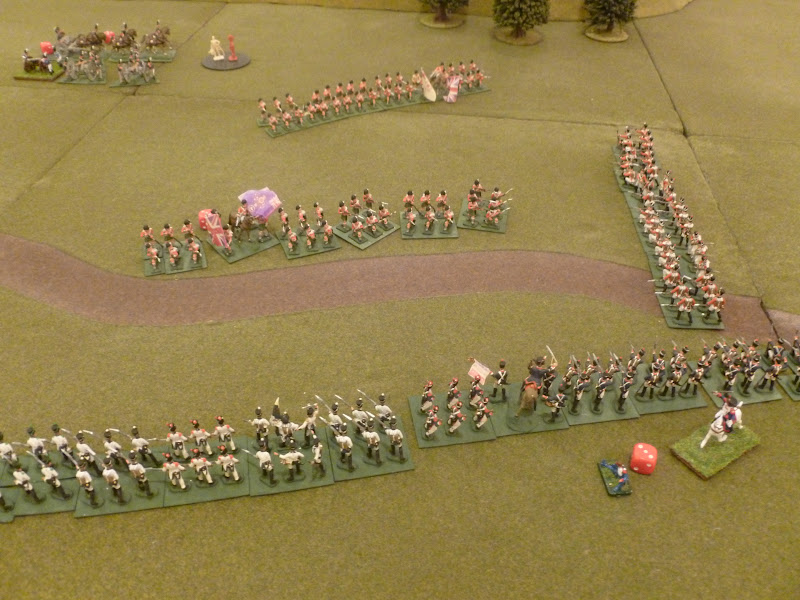
The battle was a grand affair, the British were all deployed along a large ridge as befited their long lines whilst across the expanse of open ground the French Battalions would have to march towards them, under fire from the Bitish, superior, royal artillery more manouverable and longer range.

Valmont's brigade advanced first, with one of the artillery pieces being moved nearly as far as the central road, but the other three crews were having terrible trouble with their limbers and wheels and didn't manage to move anywhere whilst the four french columns raced towards the ridge.

In the centre Balliard and his cavalry raced through the woods, hampered by the tree roots protruding from out of the ground that made it quiet hard going.
But the Old guard under Montrand lead the way for the rest of the army. They charged out in their massed attack column straight acroos the open ground, for the ridge, flanked by two platoons of French line, however they were sawly let down by the artillery's promblems and recieved no support from the heavy guns, despite the General's efforts.

On the right Dubreton marched his multinational platoons straight forward in a strong steady line of attack columns. However what, exactly, he was marching for was a mystery as the Britsih had deployed far less men on this flank then had previously been expected

As the French came on in their dense formations, Sir William Erskine decided to abandon the positions along the ridge and march out to meet the oncoming French men. On his left he drew up a battery of three horse guns along with the 42nd highland regiment and a platoon of free prussians. Currently, however, they were out of range of firing on the advancing columns.

On the British right two large groups of Scots Greys went straight for the French gun, limbered and so far forwards ahead of the army. But their charge failed to reach it and thy took several casualties from return fire from the French line infantry whilst the french artillery continued to struggle at unlimbering their gun.

Towards the centre Erskine threw up another battery of three horse guns, ready to fire on the advancing French men, supported by the 23rd Welsh Fusiliers just behind them. Wellington's brigade and the 95th rifle detachments, however, sencibly refused to obey Erskine's orders and leave their position on the ridge.

Balliard regrouped his cavalry in the woods and tried to get them to charge the horse artillery to their left, but with far too many of the riders knocked from their horses the cavalry brigade wasn't moving anywhere.
With allot better luck than Balliard General Reynier managed to get all three guns limbered up and moving towards the ridge, though it would be a while before they could be brought to bare.

With one shout of "Vive L'emperuer" the Old guard, seeing the gun line drawn up infront of them, fixed bayonets and charged for the horse guns. But their charge fell just short of the gun's muzzels and with no support near by it was likely many a guardsman would be slain on the muzzels of the British guns before the day was out.

Dubreton, was bringing his brigade to bear now. He had had a smooth journey till this point and now the Swiss and Westphalians would soon be firing on the highland companies. But the smaller platoon of French line were struggling to recieve the orders, being on the other side of the river.

The 42nd 2nd company came straight forwards to the road and opened fire on the French line and westphalians, taking down a few of the fusiliers and sending the french line into disorder. The Prussians had also moved up to the edge of the road and sent a volley into the nearest French column.
But the Royal artillery was the worst as they opened up through the old guard, sending them into chaos and ripping through ranks of them. In all the regiments history they had probably never suffered such a catastrophe till now.

The Royal horse artillery began to open up on the French left as well, taking out some frenchmen and sending the rest into disorder. But the long range kept the damage to a bare minimum.

On the far left the Artillery had now unloaded one gun, using it to support the other line infantry's firing volleys. The shots crashed into the scots greys, tearing through the men and horses and scattering them everywhere. This flank was definatly naught but a desperate stand with the cavalry charging for the infantry units and the artillery hurrying to get unlimbered and firing as fast as possible.

Having suceeded in remounting and riding out of the woods the Brandenburg dragoons and horse grenadiers make a brake across the open ground and straight for the royal artillery position. Balliard remains to the rear however as the Empress dragoons still attempt their a remount.
With the punishing fire from the artillery battery directly infront of them crashing into the French column just metres away, the platoon furthest away from Valmont takes the oppurtunity of a "misinterpretable" order to make a rapid retreat back towards the cross roads, reforming behind the immobile artillery.
On the other hand, in the centre brigadier Montrand was pushing his line forwards as fast as possible and by now they were almost across the road which was the final marker before they were storming the ridge. His columns then let off a volley into the Prussians facing them, tearing through the free germans and sending them into disorder. But with no artillery of their own they couldn't deliver the kind of shattering fire that could send the enemy platoons running and with the horse artillery pounding away they couldn't counter it either.
...the artillery was lying around at the crossroads doing very little and all completly limbered up and useless despite all general Reynier's attempts.
Dubreton and his multinational brigade was now facing off across the road against the 2nd company of the 42nd highlanders. The Westphalians formed a line and shot off a salvo of musket fire into the highlanders, disordering their line, But not before they had fired off a volley of their own into the French between the German units. The shots scattered the Frenchmen, taking down several with the flying shot.
Wellington with the 16th bedford, 2nd coldstream and 32nd cornwall regiments remained attop the ridge, refusing to ride down and aid Erskine's suicidal stand at the bottom of the ridge and trying to insist that he retire to his previous positions.
General Reynier, on the other hand, remained at the crossroads near the village, attempting to get the Artillery forwards and bringing supporting fire to the columns but to little avail.
Dubreton's flank was performing excellantly as he steered his multinational brigade against the Highland brigade. The 42nd highland regiment was now surrounded, with a long line of Westphalians and French line firing into their ranks from across the road and the Swiss enfilading them straight along the road. The black watch was now suffering heavy casualties and were still attempting to keep their scattered line together.
But, not far away, the "Gay Gordons" as they are known to the other highland regiments were marching towards the swiss, preparing to counter enfilade them!
Reynier had by now managed to supply Montrand with a single artillery piece to help his advance and with the French columns changing formation to a firing line the free Prussians fought for all they were worth to hold on to their position along the road, encouraged by the royal artillery fire ripping through the French voltiguer's massed column.
On the far left the French were forming a formidible gun line with two artillery pieces and two platoons in their lines sending off volleys into the Scots greys (who had fallen back to the road before regrouping for a renewed charge). As the British cavaly charged the French let off a final volley from both platoons and both artillery pieces, this smashed through the charging horsemen hurling riders from their saddles and pumeling horses into the ground. The British cavalry turned tail and fled from the field. The French gun line had somehow managed to fend off the British cavalry and secre their guns in a forward position. Both flanks were now secured by French troops and the line was fast closing in on the British Brigades.
The Brandenburg Dragoons drew their swords and charged for the Royal artillery battery which had sent the French columns into retreat. They overwhelmed the first two guns, taking but one casualty before turning their charge towards the Welsh fusiliers.

As the Dragoons regroup to finish off their charge into the welsh fusiliers, the welsh foot form a square with the remaining artillery crew and the royal artillery commander in their centre. The Dragoons had now taken out the battery on the left leaving Valmont's Brigade to advance on the ridge secure from artillery fire.
Montrand, having overwhelmed the free Prussians, taking every last man down with his men's salvos had now crossed his Brigade over the road and was now marching on the remaining artillery battery and the 1st company of the 42nd highland regiment.
With one last volley Dubreton's Westphalians sent the 42nd's 2nd company packing and began to advance on the ridge. The swiss on the other hand had been sent into confusion by the Gordon's enfilading shots but would be turning their line on the highlanders soon.
The British left was crumbling as Dubreton smashed his way through the highlanders and Montrand marched his men straight onto the Royal artillery's guns. The road was now securely in French hands and the highland brigade quite broken.
On the British right Wellington and the 95th rifles continued to leave their positions on the ridge. Meanwhile Erskine's brigade at the bottom of the ridge was being surrounded and forced back onto the ridge. The French artillery and cavalry were now supporting the infantry columns in advancing on Wellington and Erskine's positions.
Montrand's Brigade, advancing on the 42nd 1st company and royal artillery battery, soon fell into confusion as the Scottish volleys and British round shot tore through their ranks, but the French were in command of the road and fast advancing on the battery.
General Reynier had given up attempting to move the artillery and Empress dragoon forwards by now and was simply recieving his Aide de camps with news on the battle from the crossroads where he stood.
The battle of Sabugal was over and with the French in posetion of the majority of the field and having broken the cavalry brigade, the 42nd's 2nd company, ovverun a grand battery of artillery and slaughtered the free prussians to only one platoon of line infantry and the imperial guard. Thus it was declared a French victory and Sir Erskine was declared mad and cashired before he lept out of a wondow in Madrid shouting "Why did I do that?"

An excellant game and one of the largest armies I've ever single handedly commanded. It looks fabulous in the photos (I am using a borrowed camera so apologies for blurry pics) and it looked even better playing on it!

On the painting tray: ECW rupert's cavaliers and SYW Prussian fusiliers and grenadiers  

Thursday, 19 July 2012

Accident at Baro Gorge 1898, first game

This was my second run of accident at baro gorge, this time at my local modelling club. My opponent provided the terrain for the game so it looked brilliant set in an African scrubland. We used black powder as of last time and all the models i had used last time as well. I kept deployment the same for both armies and also the objective: fighting retreat. The only differences were that we used three brigadiers a side with no general for either force.
The unit stats were based around the Sudan scenario in the black powder rulesbook with the French taking the stats of the British highlanders and the Ethiopians taking the stats of the Beja spearmen (given first fire to represent limited ammunition carried by some warriors and without fanatics).
If you didn't read last time's game the basically the game is based on Colonel Marquis Christian de Bonchamps' failed march to Fashoda in 1898. Its well know that after many ambushes and the hostility of the local Ethiopians Bonchamps was forced to put back after an event known as the Accident in Baro Gorge on the border of Ethiopia and the Sudan (had Bonchamps succeeded in his march on Fashoda it is doubtful weather Kitchener would have sailed down the Nile to oppose him).

The 1st (guard) and 3rd platoons of tirailleurs, together with the company heavy machine gun were drawn up in line to form a rearguard with their backs secured to the trading post and the Oasis. They were under the command of Lieutenant Balliard with Colonel Bonchamps stationed on the roof of the trading post to observe procedures.
The 2nd platoon of Tirailleurs, under Lieutenant Louis Ney, was formed in march column along Baro road with the job of breaking the fifty or so tribesmen, under Timothy Sahle, preventing their escape. On his right flank Ney was supported by the Spahi cavalry, riding through the undergrowth to flank Sahle.
As the Tirailleurs stood formed beneath their colours, drums and trumpets playing they could see nearly a hundred or more of the natives coming from out of the undergrowth towards them, with their commanders Tewodros and Paulinus riding behind them.
At the other end of Baro gorge Tomothy Sahle stood atop his camel with his warriors denying the French any route of escape. If Sahle held then the French would be massacred to a man by Paulinus and Tewodros, it all rested on the shoulders of Lieutenant Ney to dislodge Sahle's natives and evacuate the rest of his force from the gorge.
Ney quickly ordered the 2nd platoon to advance down the road where they formed a line and opened fire on the natives. They took out a few of the warriors and sent the rest into disorder. The Tirailleurs then fixed bayonets in expectance of a charge and prepared  another volley. The Tirailleurs line would soon be tested with a charge from the natives and if it held then perhaps the charge would be turned.
The spahis, underestimating the urgency of their assistance, trotted gently through the undergrowth with their sabres drawn and shouldered. Their shattering charge could easily roll up Sahle's flank but would it be in time with their badly timed in-activeness. The 1st platoon under Lieutenant Balliard fell back to cover the 3rd platoon with their fire as well as protecting Ney's rear from the oncoming natives.
Bonchamps and the 3rd platoon on the other hand held firm, secured between the post and the oasis, straddling the road and with the Machine gun covering their flank.
As Paulinus spurred his warriors on along the road; Bonchamps ordered a volley which roared out from the line, crashing into the native warriors and taking several out. But the machine gun's supporting fire flew wide and tore up the ground instead. An unlucky piece of firing and, seen as it was so important to time the departure of the machine gun just right so as not to lose this expensive piece of equipment to the native tribesmen.
The charge was innevitable and crushing. A force of natives four times their number came crashing down upon the 3rd platoon and their machine gun. The charge was met by a strong volley from the Tirailleurs, followed by the firmly braced bayonets of the Algerians. The machine gun let off a sweeping wave of shots which tore through the ranks of natives in front of it.
Down the other end of the gorge the native line also broke ranks and charged for the 2nd platoon. They were met with a similar volley which took down several of the warriors, however they still closed with the French men and soon bayonets were clashing with shields and spears. But the third platoon held out against the tribesmen and sent half of them packing whilst holding the others up with their bayonets.
The lines were holding up well and the Spahis would be on Sahle's flank and then off down the road if everything went to plan. The machine gun looked like it would soon be overwhelmed and with it perhaps the 3rd platoon, but the guards were already moving to cut off the road lower down.
The machine gun crew managed to cut down a tribes man, but lost one of their own, however this with the casualties from the first volley was enough to send the natives opposing them flying in every direction. After this lucky escape the remaining crewmen quickly dragged their Machine gun up into the trading post.
The 2nd platoon was still fighting off Sahle, but now they were aided by the Spahis' perfectly timed flank charge. The 3rd platoon was also holding out well against the tribesmen, outnumbered nearly three to one the Tirailleurs still had the best of it, cutting down the natives with every thrust of their bayonets.
Lieutenant Balliard was also marching the 1st platoon back for the road, if the 3rd broke they could cover their retreat and open ranks to let them escape whilst holding off the rest of the natives. As with all fighting retreats it was a procedure of many complex manoeuvres in order to evacuate as many men as possible.
The 3rd platoon was still not giving an inch of ground and had even sent part of the Ethiopian line into flight but they had rallied a few paces back with the encouraging words of their war leaders. Bonchamps could see that the line was wavering even so, there would soon have to be a retreat but only once the guard platoon was in a position to cover them.
The spahis soon broke the natives, cutting them down as they ran before capturing Sahle and continuing down the gorge road. The way was clear for the French to make their retreat but they had now lost the 2nd platoon and should they loose another two they would be done for.
Bonchamps looked down upon the bayonet fighting from the trading post. The tribesmen were throwing themselves at the line with everything they had, but still the Tirailleurs held strong. The machine gun was by now loaded on a donkey and being hauled along the road, but it was a stubborn mule and it was slow going. Should the natives over run the 3rd platoon and the machine gun then all hope of Bonchamps maintaining his reputation and making it back to Eritrea would be gone!
Inevitably the 3rd platoon broke ranks and ran but they soon rallied around their colours and formed ranks just ahead of the 1st platoon. They were in a good position and any native attack on them would be one where they could meet it with equal numbers. The donkey was still not moving and the machine gun was in danger and falling into enemy hands.
The 1st platoon began to fall back as the natives sent their largest and down the road to meet the 3rd tirailleurs. But the 1st were all ready readying their rifles for a volley, as the other band of tribesmen made its way round the Oasis on the flank of the 3rd. It was the most decisive moment of the action! Should the 3rd be overrun, wavering as they were, then no doubt the machine gun would fall into the hands of the tribesmen. This one simple collapse would lose Bonchamps the battle, the reputation and possibly his life
However a volley from the 3rd platoon, followed by several thrusts of the bayonets, left the natives in flight. The other band making its way round the Oasis was quick to realise the hopelessness of continuing and left the Frenchmen to continue their march up Baro road.

Another decisive French victory and, as in our test game, as close as could be desired, though as in the test game again, the Ethiopians had the worst of it but could have still pulled it off even at the bitter end.
I've found for a scenario of my own invention this game works remarkably well with a similar outcome each time, but still with the closeness that makes a game enjoyable for both players.


Tuesday, 3 July 2012

The straits of Brscak and Golac, 394 BC

Apologies for the lack of blog posts recently but I've been doing allot of painting and not much gaming. Since painting my Ethiopian force for Baro Gorge I have been working on my Royalist-Rhinelander force for the ECW game in October as well as painting up the new Empire models that I bought in May, I've also finished off a large band of Boxer Rebels for a skirmish game I'm working on for tale of two gamers and I'm also trying to get the French forces finished before I start touring the clubs with Baro Gorge. To cap it all off I'm also working quite hard on getting my 8 ft by 4ft gaming Mediterranean style gaming board finished off. Any way as you can see I've got my hands full with allot of exciting gaming projects (did i mention the 2000 model re-enactment of Balaclava I'm working on) which will hopefully be gracing your screen soon. If you can stand my excuse making for a little longer I'll also say that my camera card broke and I currently have to beg, borrow or steal cameras to record my games.

Anyway on with the report. Today we were having a game of naval conflicts in the ancient world, using top down paper models and rules I had been given after a lareg Peloponessian war game at my house. The rules are fairly straight forwad.
Each ship moves 6" (losing 2" for each 90 degree or lower turn it makes). If you are over 3" away from an enemy ship you can choose to ram the ship or shear its oars (this is where the ship runs alongside another one ramming, off its oars as it goes). If sucessfully rammed (5+ on the rear or front 3+ on the sides) then the ship is sunk, if sucessfully sheared (5+, 4+ for Athenians) then the ship moves at half speed for the rest of the game, if sheared twice then it is removed. You can also choose to board an enemy ship from what ever range, in a boarding action both players roll off (with Spartans winning draws) and the player who rolls the highest boards the enemy ship and scuttles it (I have often thought it would be fun to allow the boarder to capture the enemy ship and treat both ships as having been sheared).

The story behind today's action was that a Corinthian fleet, leaving the safety Molat harbour (an island off the coast of Illyria in the Adriatic), was beset upon by a similar sized Spartan fleet whilst traversing the straits between the islands of Brscak and Golac. Having been at war with the Corinthians for a year now the Spartans were determined to crush this small force in the Adriatic.

Our normal band of gamers was today joined by a good many others. The Spartan fleet was split into two groups of six ships under the command of my Napoleonic gaming partner and another who was new to wargaming. The Corinthian fleet was split into three groups of four ships with us two from tale of two gamers and another who was new to wargaming in command of the fleet. I'm the four on the left.
As the Spartan fleet advanced I ordered my four ships to hold their positions and keep just out of range of a ram attack from the Spartan fleet in the hope that should the dare to approach more than 6" away from my ships we would ram em! The central Corinthian fleet on the other hand sent one of their ships charging off to ram the lead ship of the spearhead of Spartans who had split their fleet to deal with the central Corinthian ships and the blockade runners from Golac.
The Corinthian ship in the centre, who's captain had charged her straight for the Spartans, failed to pierce the Spartanman's hull and was boarded and scuttled by the Spartan crew as the other two sheared its oars along both sides.
The cautious Spartan fleet facing off against my ships threw caution to the wind and rowed full pelt for my line of ships, upon which there was many calls and shouts for the drums to start up their beat and fast! On the right however the blockade runners faced off the Spartan fleet with neither opponent making a move.
With the spartan fleet with in easy reach to ram or shear I let loose the oars and went speeding into the enemy vessels. Three of my ships tried to shear the spartan craft but in the confusion only one of the ships was successful. My last ships attempted to ram the Spartan adversary but failed to penetrate and prepared to counter the inevitable boarding party. In the centre the three remaining vessels rammed and sheared into the closest Spartanman, shearing and sinking.
And on the right there was nought but inactivity.
With my boat's charge having been avoided like a scythed chariot or an elephant upon a well drilled phalanx, being let through the open ranks unable to change course with the speed of the charge, I was now facing the prospect of a difficult manoeuvre to re-face the Spartan fleet and the possibility of being rammed whilst in the process. My one ship that had hit home however was boarded by the Spartan warriors on the vessel it had failed to hull, and they scuttled it. In the centre the remaining Spartan ships counter rammed the ships that had just sunk their companion vessel and hulled and sank them both leaving but one Corinthianman standing.
On the right the inactive Spartans, having seen the centre dealt with, decided to start up the offencive on that front and they rammed into one of the Corinthian craft, but they failed to pierce its bow and were, in their turn, boarded.
My three remaining vessels turned on the spot, two of them rammed the Spartans in the flank hulling and sinking two of them. My last ship rammed the sheared vessel in the stern but failed to penetrate it and so awaited the Spartan boarders.
In the centre the Corinthian about turned, ramming one of the Spartan vessels in the side, hulling and sinking it. And on the far right the inactivity seemed to be paying off as the Corinthian ships quickly overwhelmed all but one of the Spartan vessels with not a loss to their own fleet.
However the next phase began to see the Spartans superior fighters take their toll and all but one of my vessels were hulled and sunk by a side ram. The last remaining Corinthian vessel in the centre was also broken up, the blockade runners also lost a ship to the vessel they had failed to deal with last turn.
The Spartan ships on the right and centre flocked to my last remaining ship like vultures to carrion, three of the vessels ran up alongside her and the warriors from two of them ran on board and scuttled her whilst her warriors were scuttling the other Spartanman, the stranded warriors surrendered to the Atticans. The Golac fleet had by now scuttled the last Spartan in their midst and were setting out to try and brake through the remaining Spartan vessels on the shore of Brscak. The forces were evenly matched with the Spartans having an extra vessel which had been sheared.
As the boats began to approach each other one of the Spartan vessels was still facing the shore, so far the Spartans were outgunned if they could not turn their other vessel in time. Again the Corinthians sat their ships just out of range of the Spartans, waiting on the Spartan aggression to make the first move and gain the ram!
And true enough the Spartans moved just within ram range and found themselves all immediately rammed in their bows. The Sheared vessel's prow gave way and caved in upon the ram sending her to the bottom, whilst the other two ships withstood the ram and along with the third began their boarding actions.
One of the Corinthian vessels was overrun and scuttled but the other two both launch counter boarders and got across to the enemy vessels, sinking them. In the confusion that followed with the last four ships two more were also hulled and went to the bottom.
After being chased almost to the beach of Brscak the Corinthian vessel finally turned and rammed the Spartanman's prow, but the ram failed to breach the bow wood and the Spartan warriors surged upon the ship and accepted the Captain's surrender. Spartan victory

This game always proves an interesting one as the fleets are eact replicas of each other with neither having higher quality or quantity of vessels. The only differences are in that one side is better at boarding and the other shearing. However I can still remark that it would have been a clear Corinthian victory and not nearly by such a small margin had we employed better tactics and been a more unified force. The Golac blockade runners inactivity let the centre fall early and had they overwhelmed the Spartans earlier they could well have saved it, this would have led to the Centre being quite a resounding Corinthian victory (as it was it was only a marginal Spartan one) and this would probably have made up for my abysmal dice rolling on the left, however it was "the closest run thing you ever did see" when it came to the final showdown and the Spartan fleet escaped with but one vessel remaining, surly not enough to make it safely from the Adriatic to Sparta in war time!

Wednesday, 20 June 2012

Accident at Baro Gorge, test game

Having built up a substantial French army for the colonial period I had decided to collect an opposing force of natives so that I would be able to host games at my clubs etc. So I have started a north African Arab army using the Mahdist range by perry miniatures which I fondly term my Ethiopians.
This was their first outing and also the first time to try out my game "accident at Baro gorge".
The game is based on Colonel Marquis Christian de Bonchamps failed march to Fashoda in 1898. Its well know that after many ambushes and the hostility of the local Ethiopians Bonchamps was forced to put back after an event known as the Accident in Baro Gorge on the border of Ethiopia and the Sudan (had Bonchamps succeeded in his march on Fashoda it is doubtful weather Kitchener would have sailed down the Nile to oppose him).
The Scenario featured a French force (composed of three platoons of Tirailleurs, one of Spahi and a Machine gun under Colonel Bonchamps, Lieutenant Louis Ney and Lieutenant Balliard) making a fighting retreat from the much larger Ethiopian force (composed of six platoon sized units of warriors under the guidance of Warleader Paulinus, Timothy Sahle and Tewodros) attacking it.
The French force's objective was to hold off Paulinus and Tewodros from their rear whilst breaking through Timothy Sahle's men across the gorge before making an escape down the gorge with at least three units. Alternatively the French could make a stand and attempt to annihilated the Ethiopian force.
With that we deployed the models and set about fighting the battle.
Two Platoons of Tirailleurs, armed with a machine gun, stand under the watchful eye of Colonel Bonchamps and Lieutenant Balliard to attempt to hold off nearly a hundread Ethiopians not feet from them. Meanwhile Lieutenant Ney leads the Spahis and a column of Tirailuers towards the band of almost fifty warriors defending the gorge.

With the warriors chanting their war cries and Sahle firing off his rifle, the shrill sound of a bugle blast rings out from the Spahi and the light cavalry fall upon the native warriors with sabres drawn. Along side them the Tirailleurs form a line and open fire with all guns blazing on the unengaged warriors.
 Meanwhile Bonchamps begins the fighting retreat and along with a platoon of the Tirailleurs and the machine gun they fall back to hold the rear of Lieutenant Ney's command. However Lieutenant Balliard and one of the platoons of Tirailleurs remain standing formed in a line between the two trees.
 As the machine gun blasts out a punishing toll on the nearest warriors, Balliard's Tirailleurs open up with their rifles. And after the issuing of a rather unclear order by Paulinus, a band of the warriors take the oppurtunity to quit the field.

Having recieved the Spahi's charge and withstood it, Timothy now sends the rest of his warriors charging forwards into the Tirailleurs line whilst the other try to withstrain the French cavalry.
As the horses force and trample their way through the warriors, casualties mount on both sides with the Ethiopians recieving the worst of it but still inflicting more than acceptible losses on the Spahis. However the force of the cavalry is to hard to hold back any longer and the natives flee back down the gorge leaving only one band and Timothy to hold the pass against the Frenchmen.
The Tirailleurs also put up a good fight and the charging warriors quickly turn tale and fall back several feet, only to be charged by the Spahis, who, after overuning their last oponents, follow up the charge down the gorge.
With War leader Paulinus and Tewodros failing to pursuade their men to advance and the French forces falling back towards the gap, now held by a small band of warriors, things look desperate for the Ethiopian forces who are even further away from completing their objectives then they were at the start.
The Machine gun, sheltered from the blazing sun in the shade of a tree, opens up with a devestating blast ripping through rank after rank of the native warriors.
Growing restless with their weak commanders and with machine gun fire sweeping through them, yet another band of native warriors take advantage of a confusing order to retire from the gorge.
However seeing that his force is rapidly falling apart Paulinus pulls himself together and moves his now dwindling force to try and brake through the French lines. Meanwhile the Spahis finally suceed in breaking the troops holding the gorge. With the way clear they falll back and re order themselves in the safety of the Tirailleur's square. Timothy Sahle however takes the opurtunity to make a brake for it, riding hard for warleader Paulinus.
With Tewodros pushing his men hard into the Tirailleurs line, Lieutenant Balliard joins the frey, leaping in amongst the men with sword drawn and revolver firing. This was the braking point, if the Ethiopians could brake the French line then they would be free to fall upon the rest of the platoons before they escaped down the gorge.
In the confusion of re organising the troops after the fighting the orders issued by the Colonel seemed to fall on deaf ears and the men marched slowly for the gorge as though they had all the time in the world, with the Spahis refusing to ride until they had watered their mounts. With but one Platoon safe and Paulinus pushing hard on his heels Bonchamps would need to act fast if he was to escape.
And true enough the cavalry's inactivity cost them dear. With Balliard and his men still locked in combat Timothy took command of the other band of warriors and pressed them hard, charging into the Spahi's rear causing a good deal of casualties.
As Paulinus rode in amongst his men to try and brake Balliard's line the fighting reached a pitch. The casualties were very great on both sides, but the line didn't look close to breaking point just yet.
Startled by the attack on their rear, the Spahis rushed of down the gorge, causing confusion in the ranks of the Tirailleurs and finally reordering themselves in he mouth of Baro Gorge. The Ethiopians now looked free to charge the Tirailleur's rear and perhaps brake them, they could even now pull this battle back if they could just brake one of unit, they were now in a position to hold the pass against Balliard, should he survive.
But Bonchamps, personally taking command of the Tirailleurs, was not about to see them brake. He descended into their ranks and reformed their line to face Timothy's warriors. Letting off several volleys of rifle fire, the soldiers of France proceeded to fix their bayonets!
Meanwhile Lieutenant Ney took the cover provided by the Tirailleurs line to reform the Spahi and send them marching for the gorge.
Having broken Paulinus' warriors and sent them packing, Balliard could now be seen marching at the head of his Platoon towards the gorge safe in the knowledge that his rear was safe. As he marched for the gorge he saw Bonchamps issuing the order to aim and the machine gun crew attaching the next hopper.
With a volley of rifle fire and a hail of bullets from the machine gun Timothy Sahle's unit was wiped out to a man, but the soon to be warleader mounted his camel and rode off. He had certainly proved his worth in making the best of a bad situation, but evidently even his skill at command could not win the day. The French force was now safe to march back to French somali land.

For a first run it went very well. The overall result was a crushing Frenc victory, with the Ethiopian force wiped out and not a single unit lost themselves. However this does not show that the odds were stacked in France's favour. The Ethiopians had blundered twice and sent two of their units from the board without seeing action, they had also failed so many command rolls that all I had to do was sit there and shoot at them saf in the knowledge they wouldn't move. Timothy Sahle put up a heroic defence and the other Ethiopian units also put up strong fights and the result was still a close one.
If the Ethiopians had been moving from turn one (rather than four) it is quiet plain that Balliard would have been overrun very early on as would the MG team and Bonchamps would have had a much harder fight to put up on the rear.
Both our command rolls for this game were terrible and had the Ethiopians been in the right place to take advantage of this then they would have most definatly won.

Still that is the luck of the dice and the fault of the warleader but ultimatly it was still a close, hard fought and fun game.