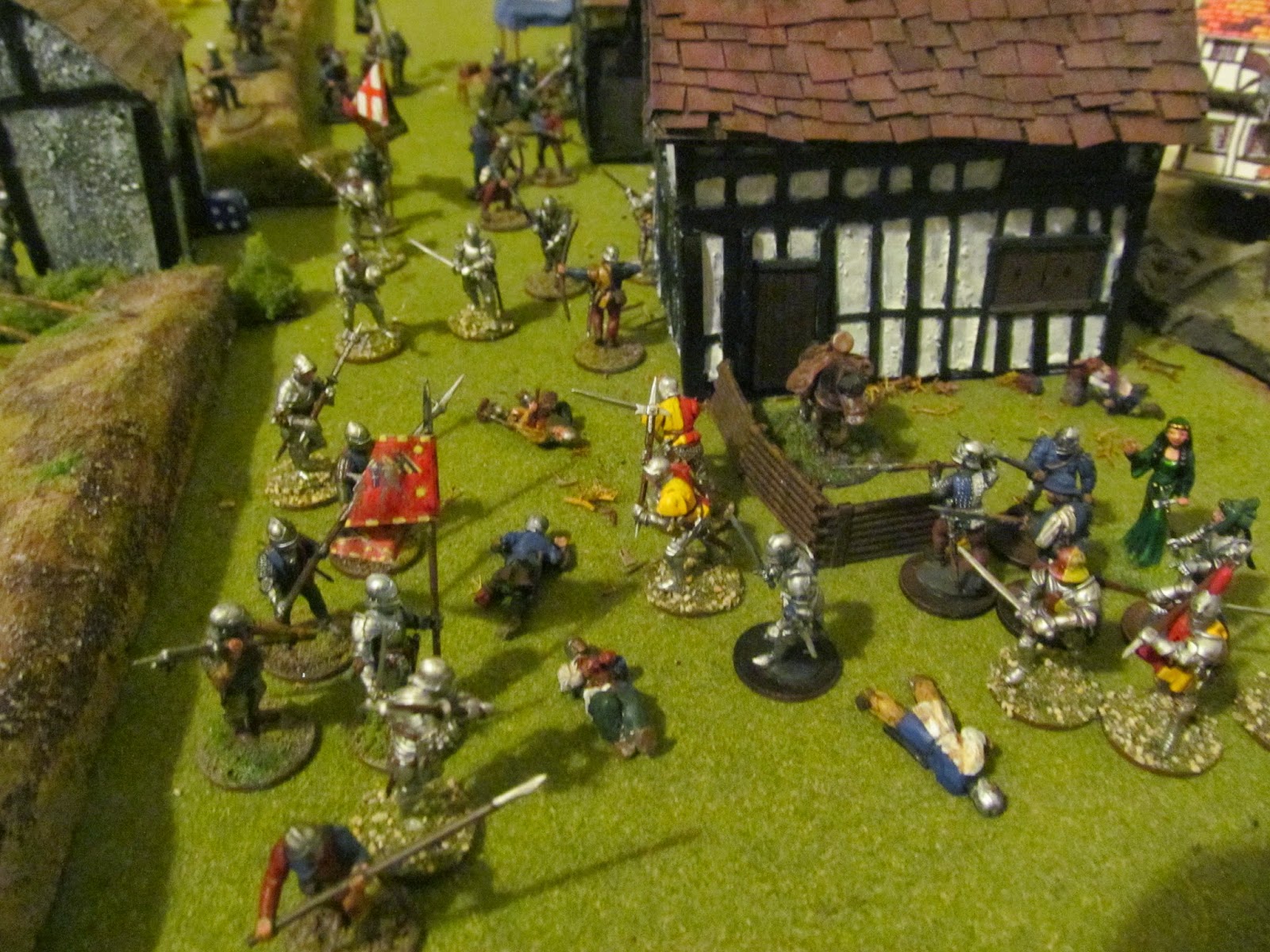
"Damn those Parliamentarian zombies!"
This particular game came about because of a small foot note in the Osprey book: Zombies, a hunter's guide. Basically it referred to a sentence in the main body of text stating that after the bloodshed of the thirty years war necromancers had been plying their trades all across Europe and that during the English Civil war these necromancers stalked the green and pleasant lands of England. The foot note stated one example of this known as the march on Salisbury plain. Basically, it said, that a large necromantic horde had been put down by a force of royalist cavalrymen. This really stuck in the imaginations of the two of us at tale of two gamers.
Since the queen's jubilee (when warlord games had lots of special offers on) I had been working on an army of Royalist cavalry for the museum game (if you haven't read it then here it is
http://warformiddleearth.blogspot.co.uk/2012/10/the-siege-of-gloucester-1643.html in the end I ran out of time and only got half of them done, I can only hope that sometime I will have so little to do that I finish of the others) and I now had a force of royalist cavalry of substantial size to use in a skirmish game such as the one we began to plan. As you can probably remember from all the Empire vs Vampire counts games we have done over the years, my TOTG gaming partner is a manic zombie collector and has literally hordes of 'em. I'm a staunch royalist so it worked.
I had meant to have this blog up for Halloween but I was struck down by some plague I must have caught from the zombies crawling all over my gaming board and spent several weeks fighting the urge to join the horde (I had quiet a bad cold) but anyway here is the game... in the end.
We used some homemade skirmish rules concocted from several sets which I found in Wargames Illustrated's 300th anniversary issue. Here are the basic:
Zombies on Salisbury plain – the dead walk
Movement
Horse – D6x2/2D6
Foot – D6
Shooting
Pistol – 4”
Musket – line of sight
Dice as in Melee save that the defender cannot cause a
wound if they roll higher than the attacker.
Modifiers –
+1 firing
+1 close range (0-2”)
Each side rolls a D6
If Defender’s is Higher – nought
If both are equal – defender falls back 2”
If attacker is 1 higher – defender may not act in their
next turn (use marker)
If attacker is 2+ higher – defender slain
Reloading
After an attacker has fired his pistol he must reload it.
Once a model has fired place a reload marker next to it.
It takes a whole turn of not acting (no melee, shooting
or moving) to remove the marker.
After an attacker has fired his musket he may reload it.
Once a model has fired place a reload marker next to it.
It takes a whole two turns of not acting (no melee,
shooting or moving) to remove the marker.
Melee
Modifiers –
+1 sword
+1 two weapons (ie hammer and sword)
+1 if charging
+1 if mounted
+1 for every model you outnumber by
Each side rolls 2D6
Equal – break apart
1 higher – defeated model(s) falls back 2” (if possible)
2 higher – defeated model slain
Simple enough. Looking back, however, its clear that we should have adopted a more lord of the rings the strategy battle game style of turn sequence rather than the classic which we did. The turn sequences seemed all too predictable.
Any way on with the game
The royalist horsemen, recently recruited from the men of Salisbury by two of Rupert's Rhinelander officers, had saddled up and ridden out that evening as the news of the necromantic horde advancing on Salisbury plain had reached them. Salisbury plain was mist wreathed and eerie as the horsemen spurred their mounts on towards the zombie hordes.
There were more than twice as many zombies as there were horsemen, but the royalists were all mounted and armed with pistols and swords, with which they were most skilled. It was clear that in combat the Royalists would own against single zombies, so the necromancer would have to attempt to get as many zombies on top of the horsemen as possible.
A couple of the zombies were armed with one shot "muskets" (handguns, crossbows, blunderbusses etc) and as the horsemen advanced two of them opened fire. The lead ball sank deep into the horse's flank and it cartwheeled over into the ground, its rider sent sprawling across the field.
Old Mick Clynde, the Salisbury magistrate, led the way on his sturdy mount, Rupert's cornet billowing as he rushed towards the foe. His fellow horsemen following with their Rhinelander leaders at the front. Both sides would soon be clashing and ensign Mick Clynde seemed eager to be the first into the frey.
As he spurred his horse on a couple more shots left the zombie horde with bangs of smoke and flame, the musket balls whizzing through the air past the royalist's standard.
But now Van Helborn, a seasoned Rhineland vampire hunter, and his trumpeter were within pistol range of two of the musket armed zombies. The pair opened fire on the animated bodies, sending one flying backwards with its head parted from his body. The other zombie received a shot to the ankle, toppling it and temporarily immobilising it.
The horsemen were almost on top of the zombies now and as they grew closer more pistols fired, included old Mick's, but with no effect. The front men shoved their pistols back into their holsters, unloaded, and drew their swords, preparing for the inevitable clash which they were so confident of winning.
Having already fired off his pistol, ensign Mick now charged into the zombie horde, slashing his sword through the air and severing a zombie in two, showing the way for the others to follow.
John Bullborough, the fanatical royalist followed the old cornet bearer's example, spurring his horse into the group of zombies bottle necking on the flank. He reigned up his horse just before it crashed into the stumbling corpses and fired off his pistol into the nearest zombie's skull. Its head exploded and it crumpled to the floor.
The line of horse was now in and dispersing amongst the zombies. However the cavalrymen refrained from slashing at the zombies, preferring to dispatch quiet a few with blasts of their pistols striking at the spinal cords of the walking dead.
But soon the zombies were moving and swords were drawn to defend themselves from the necromantic creatures. Clynde and Van Helborn each cut down a zombie whilst two others were also severed in half by the flashing blades of the horsemen.
Bullborough too was attacked by a wave of zombies, one of which he cut down, whilst seeing the others off. The other was blasted onto his back by a pistol shot from another horseman behind him.
The undead centre was badly damaged, the royalist horsemen gutting it. But it was not yet completely crushed and on the flanks two wings of zombies were pushing their way to surround the cavalry.
In the centre Van Helborn and Clynde, together with the other Rhinelander officer, were utterly surrounded and covered by swarming zombies. The three men fought heroically but there was little which they could do against such odds.
The zombies overwhelmed the chief officer and ensign, ripping apart their armour before tearing at their flesh. Only Van Helborn fought on, narrowly avoiding death by throwing his opponents from hi horse back into the dust but causing no casualties. The zombie centre was fighting back hard and didn't seem to be quiet as gutted as they had done before.
Bullborough had also been attacked by a pair of zombies, but he continued to fight on heroically, searing apart one with his blade before blocking a blow from the other's club. He was doing well, but he still had more fight in him for King and Country.
Over on the right another horseman charged off to confront the zombie threat from that direction. He trotted up to the lead zombie and split him at half at the waist with his sword before turning and riding back to his fellows.
Several zombies who had vaulted the hedge found themselves with pistols aimed directly at their heads before soon finding they had no heads. However the Zombie left wing was pushing along the hedge and with only one horseman to confront them seemed ready to overwhelm these lone horsemen.
Back with the frontal assault Van Helborn was leading the main body of horse in cutting down the zombies responsible for the loss of the Cornet. Many of the zombies found a leg cut from under them while several others found themselves in two parts.
The animated centre was very quickly crumbling away with body parts littering the ground. The best these corpses could attempt to do was to delay the main body of cavalry whilst the wings tried to envelop Bullborough and push on into the flanks.
However one wing at least was finding this task hard. Two more riders had detached themselves from the rest to held their comrade who had so valiantly ridden off into the midst of the flankers. Two zombies charged forwards to stop them but were swiftly cut down.
Bullborough continued his valiant stand as yet more corpses poured down the path between stone wall and undergrowth to confront him. He flicked his sword through the air and laid low yet another animated body.
Though almost gutted the central zombies were having their revenge, swarming two of the horsemen and dragging from his saddle one of them with the weight of numbers.
The valiant cavaliers on the right who had attempted to stem the necromantic advance with just the three of them were receiving their comeuppance. The first bold cavalryman was surrounded by three of the beasts while of the other two one was killed and the other grabbed by two zombies.
Two more zombies attacked Bullborough, but as ever the staunch mounted defender cut down one of them and parried the others blow before striking out at him as well.
The royalist right was falling fast with the horsemen being dragged down into the dust and their horses bolting back to the rest of the pack, as the zombie horde forced its way onwards in a great tide of blood and bodies.
The zombies in the centre were having their revenged as they rang the life out of several cavaliers with their grasping blooded and rotten hands. But this did not scare off their foes, Van Helborn made sure of that. The cavaliers just kept forcing their way on into the necromantic band.
On the left a surprise extra wing of zombies came round the other side of the bush and had to be confronted by two dispatch riders, who cantered up to their foes and let rip with their pistols before returning the smoking barrels to their holsters, as two zombies hit the floor, before calmly drawing their blades. Bullborough too was having his work cut out and another cavalryman rode over to help him out, slashing out the structure of the first zombie he saw.
More horsemen were now forcing their way up against the right wing horde, fury in their hearts as they sought to avenge their valiant companions. In the first charge three zombies were cut down and several more beaten back with sharp slashes of the shearing swords.
The centre was now no more than a couple of stragglers as Van Hellborn's men broke through in the war of attrition. In total seven zombies were cut down as the horses broke free from the close quarter fighting of the central killing fields.
Another zombie sucommed to Bullborough's blade bringing his total zombie kills up to seven. A heroic feet and one that would be told of round the campfires of many a royalist encampment.
But the valiant Blacksmith was no immortal and as two more zombies began to drag themselves up the pommel of his saddle he found himself with only one foot of the stirrups and was soon out on his back in the dusty field. The zombies fell on him and, weighed down by his ancient armour, he was torn limb from limb in a feeding frenzy. A minor victory for necromancy and major loss for the royalist cause.
The royalist horsemen now sought to take their revenge on the zombies coming down on their right. Several cavaliers rode off through the ranks of zombies feasting at flesh and drove them back with fierce slashes of their bloodstained swords.
In their fury to make sure that their hero BullBorough did not go unavenged a large band of horse broke away from the main clump to take on the left wing. They rode in and amongst the zombies cutting down many of them and forcing their way through to the others.
The centre had now completely disintergrated on both sides leaving a nought but a blood smeared field of dead horses and mangled corpses. The Cavalry were now seeking to destroy the last two wings of zombies which meant splitting their force in two. The Horsemen thundered down on the right ans scythed their way through the necromantic hordes.
Van Helborn and his men had, with their thundering charge, hacked and slashed their way through all the zombies that side of the hedge, leaving just two on the other side to face off against two cavaliers. Bullborough's body was recovered and would soon be resting in Salisbury cathedral.
The right too was no no more than half a dozen twitching corpses. But it was by no means easy for the royalist cavalry and they were sent dashing back from the undead creatures on several occasions. It was not casualty less for the royalists either and a couple of the riders found themselves unhorsed and hacked apart by the zombies.
And soon the necromantic beasts seemed to be having the upper hand as two more of the cavaliers were slain and their fellows forced back to the line of the wall. The zombies were free to regroup into their compact swarm which would soon be causing much angst for the cavalry.
The last zombie on the left wing proved to be a particularly difficult to deal with and even with two royalist cavalrymen attempting it he still manged to evade them and proceeded to throw itself at one of them. He slashed but to little avail.
Van Hellborn now ordered all the men on the left to reload their pistols, which they did before setting off help bolster their fellows in confronting the eight remaining zombies holding out on the right. They left one of the horsemen still unloaded on the other side of the bush to deal with the remaining animated corpse.
On the right the zombies continued to hold out stubbornly, throwing back all comers and refusing to let the horsemen get the better of them. However Van Hellborn and his pistoliers were already on their way to sort out the last abominations from a distance.
On the other side of the hedge to the right, one lone zombie also held out against a single horseman, holding him off while his sword arced through the air.
Van Hellborn's ride was now well underway with the cavalrymen cocking their pistols as they closed in on the last band of zombies. The line of horsemen at the wall had scattered in all directions and the path was open for Van Hellborn to launch his leaden assault.
The pesky zombie on the other side of the hedge finally fell to a well aimed slash across its spinal cord from the mounted cavalier.
The line of horse was now well and truly broken and the zombies began to pick off stragglers, grasping at their horses before dragging them down and swarming across them, devouring the flesh as it was thrown high into the blood stenched air.
But then Van Hellborn was upon them and his men were heralded by a hail of lead shotte, dispatching many of the walking horrors. Van Hellborn himself trotted up to a zombie and even as it grasped out at his hand holding the pistol, he pulled the trigger on its skull. Its brains burst from its head and it span over backwards. Van Hellborn returned his discharged pistol back to its holster.
The last zombie was finally dispatched by the shining blade of a plucky rider.
Victory to the riders of King Charles I's cavalry! The zombies were utterly destroyed and the necromancer driven back into the heart of Parliamentarian territory, leaving the road open for the Salisbury horse to meet up with Rupert and the king in the west.
It proved to be a great game and one which we both thoroughly enjoyed. As I said before the only problem with the rules was the turn sequence, but this can easily be amended and perhaps we will see these rules in use again at a later date.
We had intended to play it on a Tuesday at the sports centre cafe but it got postponed to the Friday evening at mine and a good thing too as we wouldn't have had anything near the amount of time it took us in the end.